
Search Warren County Court Records
Modern Warren County court records are searched through the North Carolina eCourts Portal, which serves as the public access point for Smart Search, hearing search, payments, and judgment search. Warren County moved into the eCourts environment on April 29, 2024, so current case lookup is not limited to a paper index at the courthouse. Portal results can show case status, parties, hearings, charge entries, judgment data, and payment eligibility, but the official file remains with the Warren County Clerk of Superior Court.
Before searching, gather the party name, case number, citation number, attorney name, or date range. Select Warren as the county when the tool offers a county filter. If the Portal does not show the document needed, use the public self-service terminal or request the paper file through the clerk's office. The official court-records help page also says background checks should be handled through the county clerk, not by treating Portal as a background-check product.
- Open the NC eCourts Portal and choose Smart Search for case records.
- Search by name, case number, citation number, or attorney, then narrow the result to Warren County when possible.
- Use Search Hearings when the goal is a court date rather than a full case record.
- Review docket events, parties, status, charges, hearings, and payment options with care because online entries are not certified copies.
- Contact the Warren County Clerk of Superior Court for certified copies, paper files, older records, or background-check requests.
The Warren County Judicial Branch landing page is the local gateway for court dates, records, forms, payments, and county court notices.
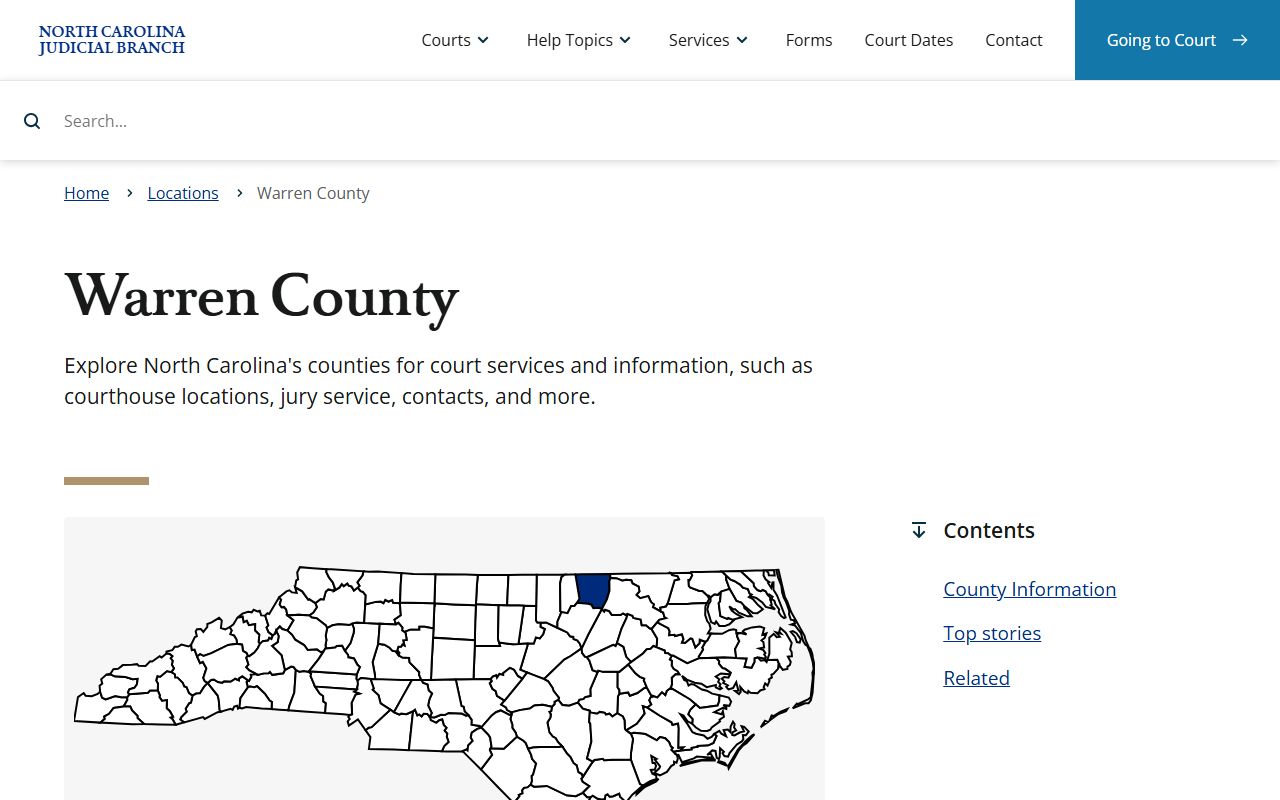
That county page is useful when a search needs both the statewide Portal and Warren-specific links such as the courthouse page, local rules, payment information, and contact directory.
Warren County Court System
Warren County courts are part of the statewide North Carolina Judicial Branch. The state court structure has an Appellate Division, a Superior Court Division, and a District Court Division. Warren County sits in Prosecutorial District 11, Superior Court District 11, and District Court District 11. Local court records are county-based, but the courts themselves are state courts rather than county-run courts.
Superior Court handles felony criminal cases, larger civil actions, appeals from District Court, and some special proceedings. District Court handles misdemeanors, infractions, traffic cases, small claims, many domestic matters, juvenile matters, and lower-value civil cases. The Clerk of Superior Court is the record keeper for both divisions and also acts as judge of probate for estates and many guardianship matters.
Case flow: Magistrate or filing › District Court or Superior Court › North Carolina Court of Appeals › Supreme Court of North Carolina when review is available.
| Court | Jurisdiction | Case Types |
|---|---|---|
| Superior Court District 11 | Primary trial court for serious matters | Felonies, civil cases at or above the state threshold, appeals from District Court, and some special proceedings |
| District Court District 11 | High-volume local trial court | Misdemeanors, infractions, traffic, small claims, domestic, juvenile, and lower-value civil matters |
| Clerk of Superior Court | Record office and probate judge | Court files, estates, judgments, copies, payments, and public terminal access |
The state court structure overview explains the unified system that places Warren County court records inside statewide Superior Court and District Court divisions.
That structure matters because the same clerk office supports both local trial divisions, while appeals move through state appellate courts rather than a separate county appellate system.
The North Carolina types of courts page explains how Superior Court and District Court divide trial work for Warren County court records.
That division helps separate felony and higher-value civil matters from traffic, misdemeanor, small claims, juvenile, and domestic matters.
Warren County Courthouse Access
The Warren County Courthouse is the physical access point for court records, public self-service terminals, paper files, certified copies, cashier functions, traffic payments, and clerk counter help. It is also the place to confirm local procedures that are not visible online, including older paper files, sealed-file access rules, and copy requirements. The courthouse page lists the main courthouse address, mailing address, telephone number, and business hours.
Warren County Courthouse
109 S Main St
Warrenton, NC 27589
(252) 257-6300
Monday-Friday, 8:30 AM-5:00 PM
Mailing Address
Warren County Courthouse
PO Box 709
Warrenton, NC 27589
Use citation numbers on mailed traffic payments.
After-Hours Traffic Waivers
Magistrate's Office
103 N. Front St.
Warrenton, NC
Eligible waivers only after hours, weekends, and holidays.
The official Warren County Courthouse page confirms the court address and hours used for in-person court record access.
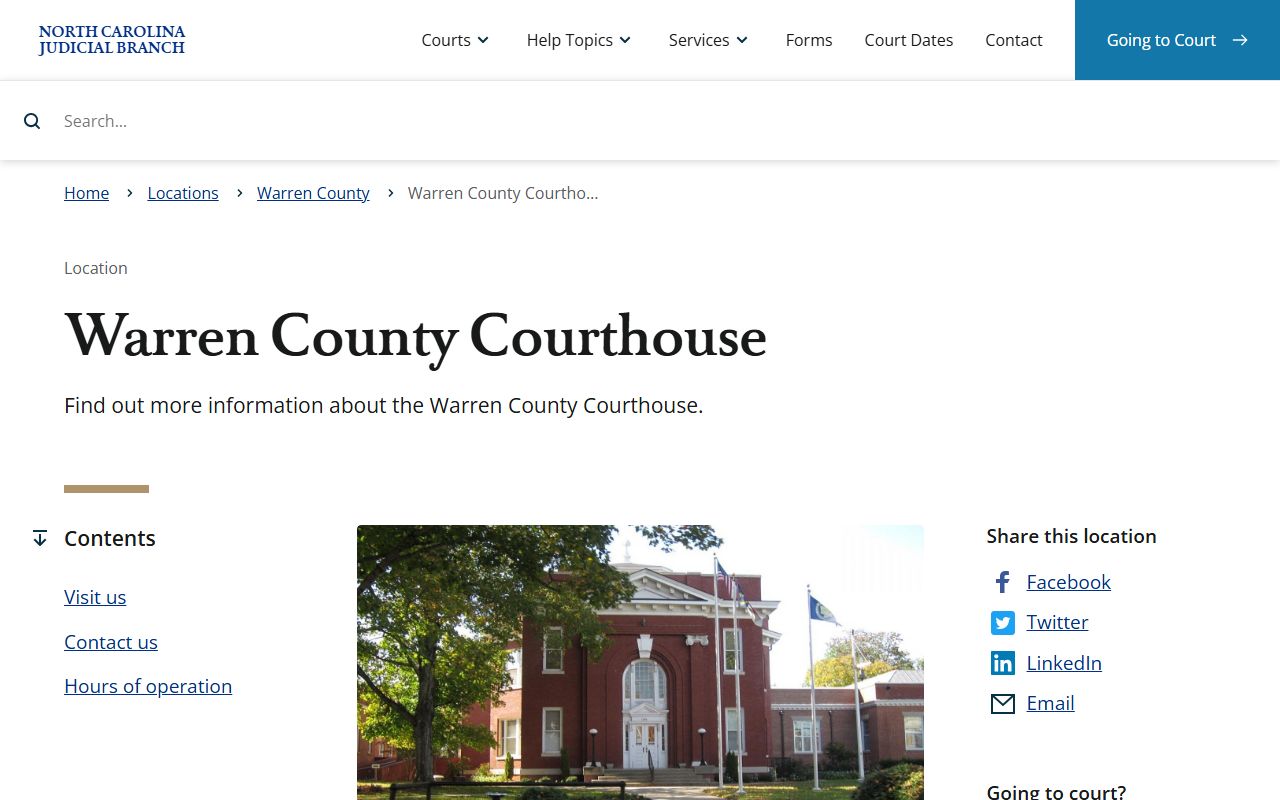
For record searches, the courthouse is the fallback when online search does not display the full file or when a certified court copy is needed.
The Warren County contact directory lists local court contacts for the clerk, district attorney, magistrates, custody mediation, and Guardian ad Litem.
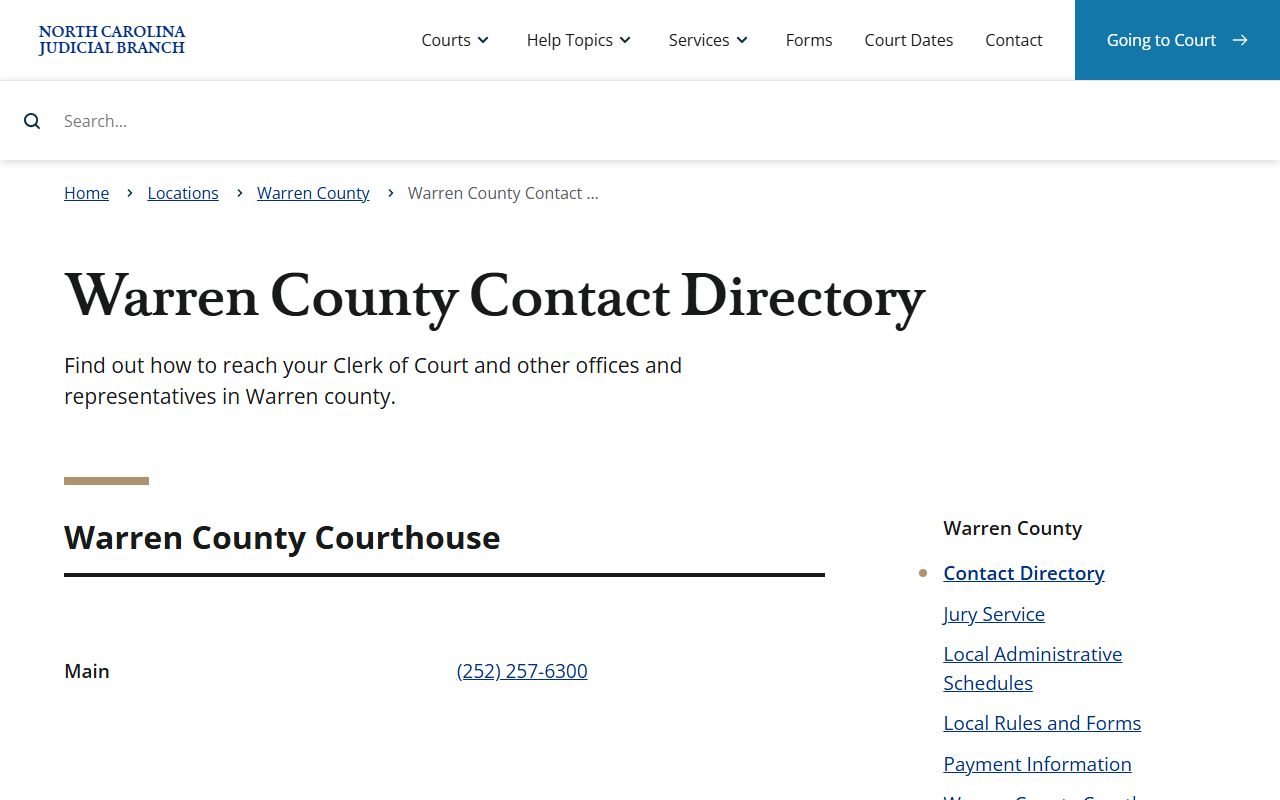
Those phone channels are useful when a Portal search result does not answer a case-specific hearing, payment, custody, or filing question.
Warren County Court Record Types
Warren County court records include civil cases, criminal cases, court charge records, traffic and infraction cases, domestic matters, judgments, estate files, special proceedings, and some public docket information. The type of record controls the search path. A traffic citation can use Portal payment tools when eligible, while a divorce judgment or estate file may require clerk contact for a paper file or certified copy.
Not every record at 109 S Main Street is a court record. Marriage licenses, certified marriage copies, birth and death records, real estate records, and genealogy records are handled by the Warren County Register of Deeds. Sheriff booking and custody information routes to the Sheriff's Office and Detention Facility at Rafters Lane, while court charges and hearings route back to the clerk and Portal.
- Criminal court records show the court case after charges are filed, including hearings, pleas, dispositions, and sentence entries.
- Civil court records include complaints, motions, orders, judgments, small claims matters, and civil Superior Court or District Court filings.
- Family and divorce records include divorce judgments at the clerk's office, while certified vital certificates may involve state vital records.
- Estate and probate records are handled by the Clerk of Superior Court acting as judge of probate.
- Traffic court records include citations, waiver eligibility, court dates, payment status, and disposition entries.
What Warren County Court Records Show
A Warren County court record usually identifies the court division, county, parties, filing date, status, case type, hearings, documents, and outcome. Criminal and traffic records may add charges, statutes, offense dates, bond, release conditions, agency, disposition, sentence, fines, costs, restitution, and probation information. Civil, domestic, estate, and special proceeding records use different party labels, such as plaintiff, defendant, petitioner, respondent, estate, guardian, or applicant.
| Field | What It Shows |
|---|---|
| Case Number | eCourts or legacy identifier used by the clerk and Portal to track the file. |
| Filing Date | Date the case, citation, petition, estate, or court document was filed. |
| Parties | Names and roles such as plaintiff, defendant, state, petitioner, respondent, estate, guardian, or attorney. |
| Charges / Cause | Offense, statute, civil claim, petition type, estate matter, or judgment category. |
| Disposition | Result such as dismissed, disposed, judgment entered, plea accepted, closed, appealed, or transferred. |
| Sentence / Judgment | Court-ordered punishment, costs, restitution, probation, civil judgment, or estate order when applicable. |
Warren County Court Records Access Law
North Carolina court record access starts with the court-specific clerk statute. N.C.G.S. 7A-109 requires clerks to maintain court records, dockets, files, and indexes, and makes them open for public inspection during regular office hours unless a law blocks access. For county agency records outside the courts, N.C.G.S. 132-1 defines public records more broadly.
The split matters. Court files, dockets, judgments, and probate records route through the Clerk of Superior Court. Sheriff administrative records, detention questions, and county department records may use Chapter 132 channels. Sealed, expunged, juvenile, adoption, mental health, and protected personal data are not treated like ordinary public court records.
Key Statutes:
N.C.G.S. 7A-109 - Court records are open at the clerk's office unless another law prohibits access.
N.C.G.S. 15A-153 - Expunction clears eligible public records of expunged arrests, charges, or convictions.
N.C.G.S. 7B-3000 - Juvenile court records are withheld from public inspection except as law allows.
The Court Officials page describes the Clerk of Superior Court's record-keeping, money-collection, and probate functions.
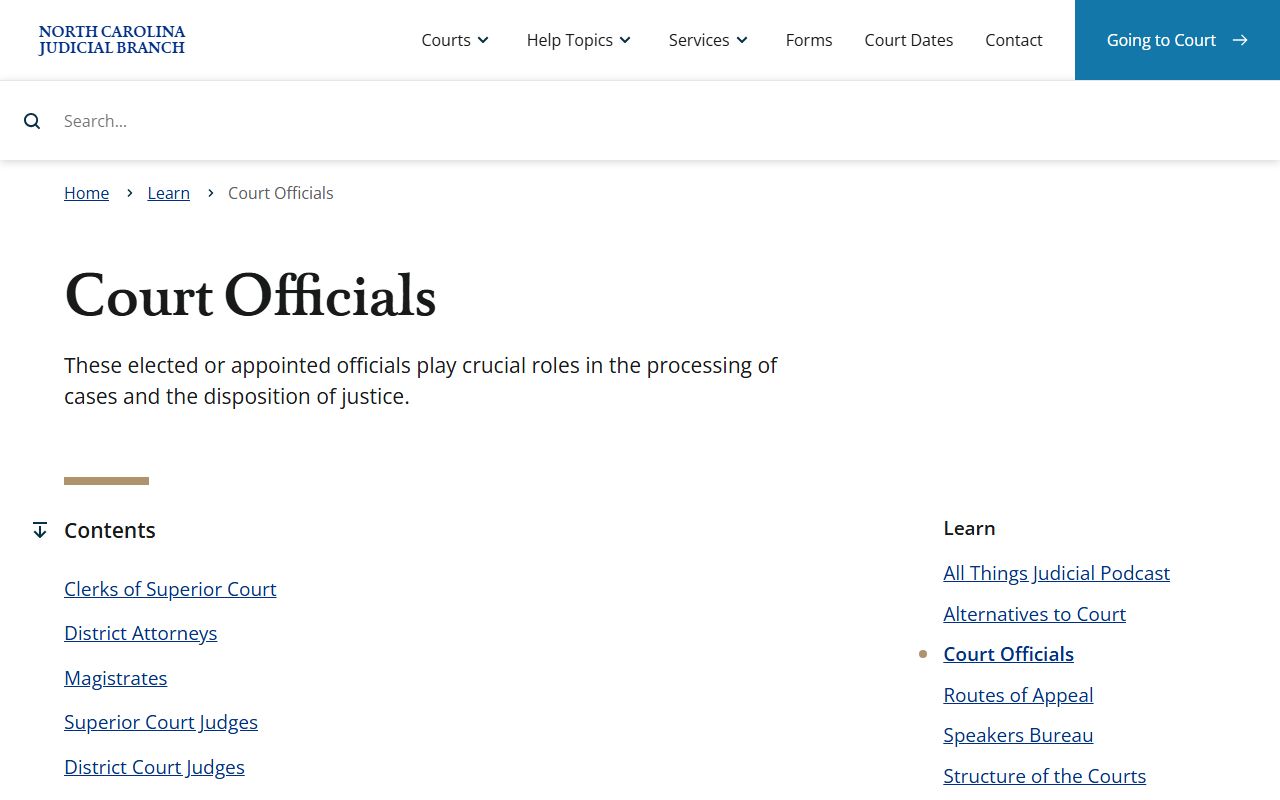
That clerk role is why certified copies, paper court files, estate records, and many payment questions return to the same Warren County court office.
Restricted Warren County Court Records
Juvenile records, adoption records, sealed cases, expunged criminal records, mental health proceedings, protected addresses, medical information, Social Security numbers, financial account numbers, and certain minor-related details can be withheld, sealed, or redacted. A Portal search that does not show a record may mean the case is sealed, restricted, older, not indexed, or only available through the clerk.
Expunction is the main court process for clearing eligible criminal records from public view. Adult criminal expunction depends on the charge, outcome, waiting period, prior record, and statute. Juvenile expunction uses separate juvenile forms and rules. Public users should not rely on a third-party site to decide whether a Warren County court record is legally sealed or expunged.
Warren County Court Programs
No Warren-specific official drug treatment court, veterans court, DWI court, or mental health court page was located in the research file. Warren County court users may still encounter court-connected programs and District 11 procedures, including custody mediation, Guardian ad Litem, interpreter forms, bail and pretrial release policies, and civil or criminal case management plans.
The Warren County local rules and forms page lists local administrative orders, case management plans, bail policy documents, interpreter forms, and courtroom procedure materials.
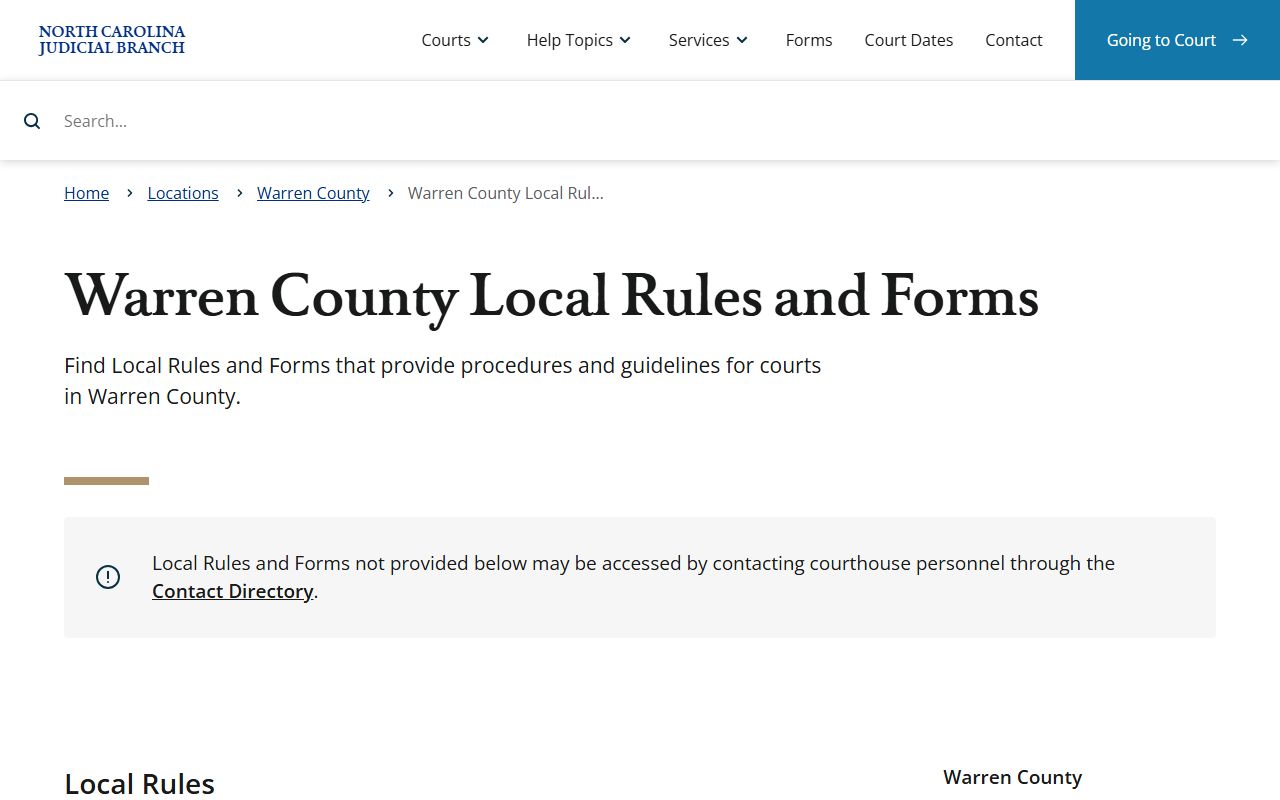
Those local materials are the best source for Warren-specific courtroom rules, including entry screening and electronic-device orders.
Warren County Sheriff and Jail
The Warren County Sheriff's Office is led by Sheriff John Branche and is based at 132 Rafters Lane in Warrenton. The Sheriff's Office publishes administration, non-emergency, detention center, and drug hotline numbers. The Warren County Detention Facility is at the same Rafters Lane complex, but official sources did not locate a public online jail roster for Warren County.
For custody status, the research-supported path is to call the detention center. For court dates and criminal case status after booking, use Portal or the Clerk of Superior Court. For state prison, probation, or parole records, use the NC Department of Adult Correction offender search. For registry searches, use the NC SBI sex offender registry. The Warren County inmate records page explains the no-roster gap and the official phone chain.
Warren County Marriage and Probate
Marriage records are not held by the court clerk. The Warren County Register of Deeds issues marriage licenses, keeps marriage records, and provides certified marriage copies. The office reports marriage records since 1867, birth and death records since 1914, and real estate records since 1756. Divorce judgments, by contrast, are court records obtained from the Clerk of Superior Court in the county where the divorce was granted.
North Carolina probate is handled by the Clerk of Superior Court acting as judge of probate. Warren County estate files can include wills, applications for probate, letters testamentary, inventories, notices, accountings, guardianship filings, and special proceedings. The marriage and divorce records and probate records pages separate the Register of Deeds process from the clerk's estate and divorce record process.
- Testator
- Person who made a will.
- Executor
- Person named to administer an estate under a will.
- Guardian
- Person appointed to handle care or property for a minor or incompetent adult.
Warren County Court Payment Rules
Warren County payment rules depend on the case and payment channel. Paper court document copy fees and certified court copy fees were not located in a Warren-specific official source, so those should be confirmed with the clerk before mailing a request. The county payment page does provide firm local rules for court costs and eligible traffic citation payments.
| Item | Rule |
|---|---|
| Mailed court payment | Money order or certified check only; no cash or personal checks. |
| In-person court payment | Cash, credit/debit card with processing fee, money order, or certified check; no personal checks. |
| Online payment | Credit/debit card plus processing fee for eligible cases. |
| After-hours traffic waiver | Eligible waivers may be paid at the Magistrate's Office after hours, weekends, and holidays. |
The Warren County payment information page lists mail, in-person, online, and after-hours traffic waiver channels.
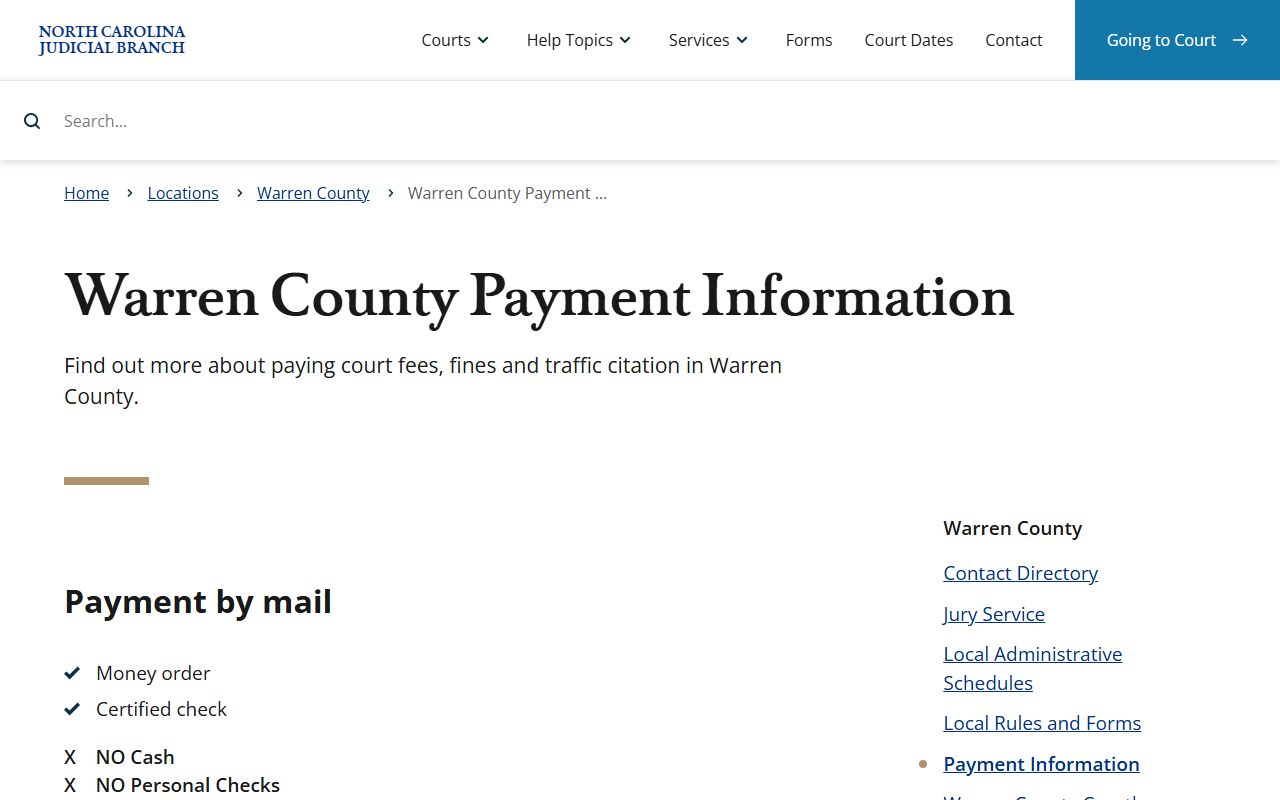
Payment eligibility is case-specific, so a search result should be checked before assuming a fine, cost, or waiver can be paid online.
Read Warren County Court Records
A charge is not the same as a conviction. A Warren County criminal record can show a charge filed after arrest, a later amended charge, a dismissed count, a plea, a verdict, or a sentence. A docket entry is also not the same as the full document. It is a chronological event line showing that something happened in the case, such as a motion filed, hearing set, order entered, or judgment recorded.
Common terms matter. A disposition is the result of a charge or case. A judgment is the enforceable court decision. Bond is a pretrial release mechanism, not a final sentence. An indictment is a grand jury charging document used in many felony cases. When the online entry is unclear, the clerk's paper file or certified copy is the better source.
Warren County Record Limits
Portal search is useful, but it is not a replacement for the clerk's official file. Older paper files, certified copies, restricted records, divorce judgments, estate documents, and background-check requests may require clerk contact. Portal also uses CAPTCHA, requires JavaScript and cookies, and may show different information to anonymous, registered, or elevated-access users.
Online data may lag behind a hearing, payment, recall, or court order. Sheriff custody status, jail booking status, court charge status, and state offender status are held by different agencies. Warren County record searches work best when each source is used for the record it actually maintains.
Note: Confirm urgent hearing, warrant, custody, and payment questions with the originating Warren County office before acting on an online result.
Warren County Court History
Warren County has deep courthouse-adjacent records. The Register of Deeds reports real estate records since 1756, marriage records since 1867, and birth and death records since 1914. Those records are not all court files, but they show why Warrenton remains the record-access center for court, land, family, and estate research.
The largest recent access change was the April 29, 2024 eCourts launch for Warren County. That placed Warren County into the statewide Portal and Odyssey environment for modern case search, eFiling, hearings, payments, and judgment search, while the Clerk of Superior Court remained the official keeper of court files.
The North Carolina Superior Court page explains the statewide trial court division that handles Warren County felony, higher-value civil, and appeal work.
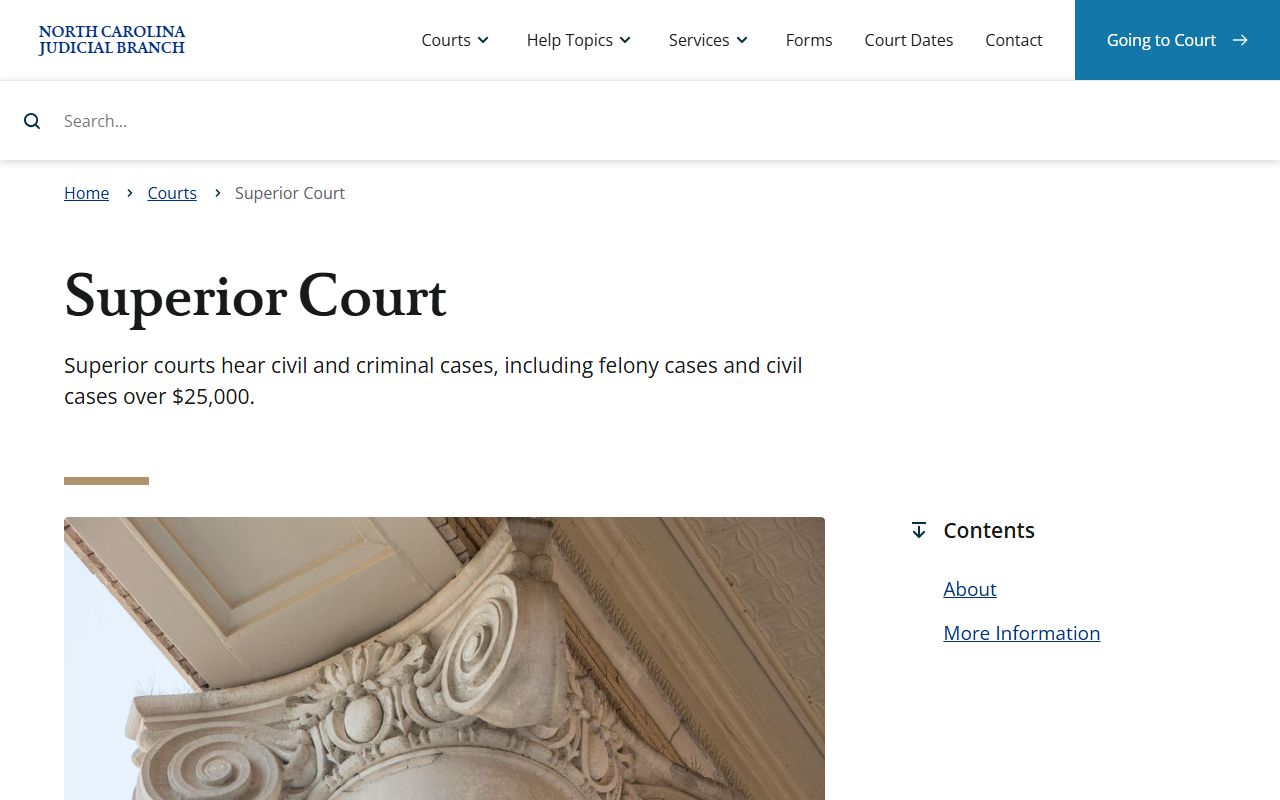
That statewide division is why Warren County Superior Court judges and calendars function as part of a state court system rather than a county-created court.
Frequently Asked Questions
Can Warren County court records be searched online?
Yes. Current case information can be searched through the NC eCourts Portal. Use Smart Search for case records, Search Hearings for court dates, Make Payments for eligible cases, and NC Judgment Search for indexed judgments. Certified copies and full paper files still come from the Clerk of Superior Court.
Does Warren County have an online jail roster?
No official Warren County online jail roster was located in the research file. The Detention Facility publishes a phone number for custody questions. State prison, probation, and parole records are searched through NC Department of Adult Correction, not the county jail.
Where are Warren County marriage records kept?
Marriage records are kept by the Warren County Register of Deeds. Divorce judgments are court records at the Clerk of Superior Court, and divorce certificates may also be requested through North Carolina Vital Records.